
Home » 2010 (Page 3)
Yearly Archives: 2010
The Great Mosque of Rome and the Little Community of Sant’Egidio
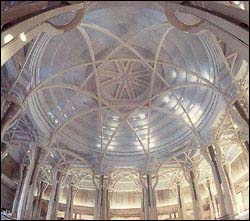
Rome Mosque, interior
American Dominican Robert Christian joined us to begin the day with the Eucharist. One of my professors at the Angelicum, Fr. Christian and I share a ministry in common – for a few months at the beginning of our service to the church, we each served as campus ministers in the Archdiocese of Seattle. He, at the Newman Center at University of Washington for a few months in 1985 and me at the Shalom Center at Western Washington university for a few months in 2003. His specialty is St. Thomas and sacramental theology, and is an excellent preacher.
We spent the morning at the Great Mosque of Rome, lead by former Lay Centre resident Mustafa Cenap Aydin of Turkey, and co-founder of the Istituto Tevere Centre for Dialogue. Unlike the synagogue and the many churches of Rome, the mosque is well outside of the historic centre and difficult to get to without a car. The design incorporates colors of classical Rome, familiar Arabic elements, and modern adaptations, including pillars in five parts to recall the five pillars of the Islamic faith and call to mind palm trees that might be found in Mecca. Various nations contributed parts of the mosque, from the careful mosaic to the suras encircling the worship area. The use of hidden natural light and the local colors mix with the exotic elements to provide a meditative space that can handle 2500 worshipers.
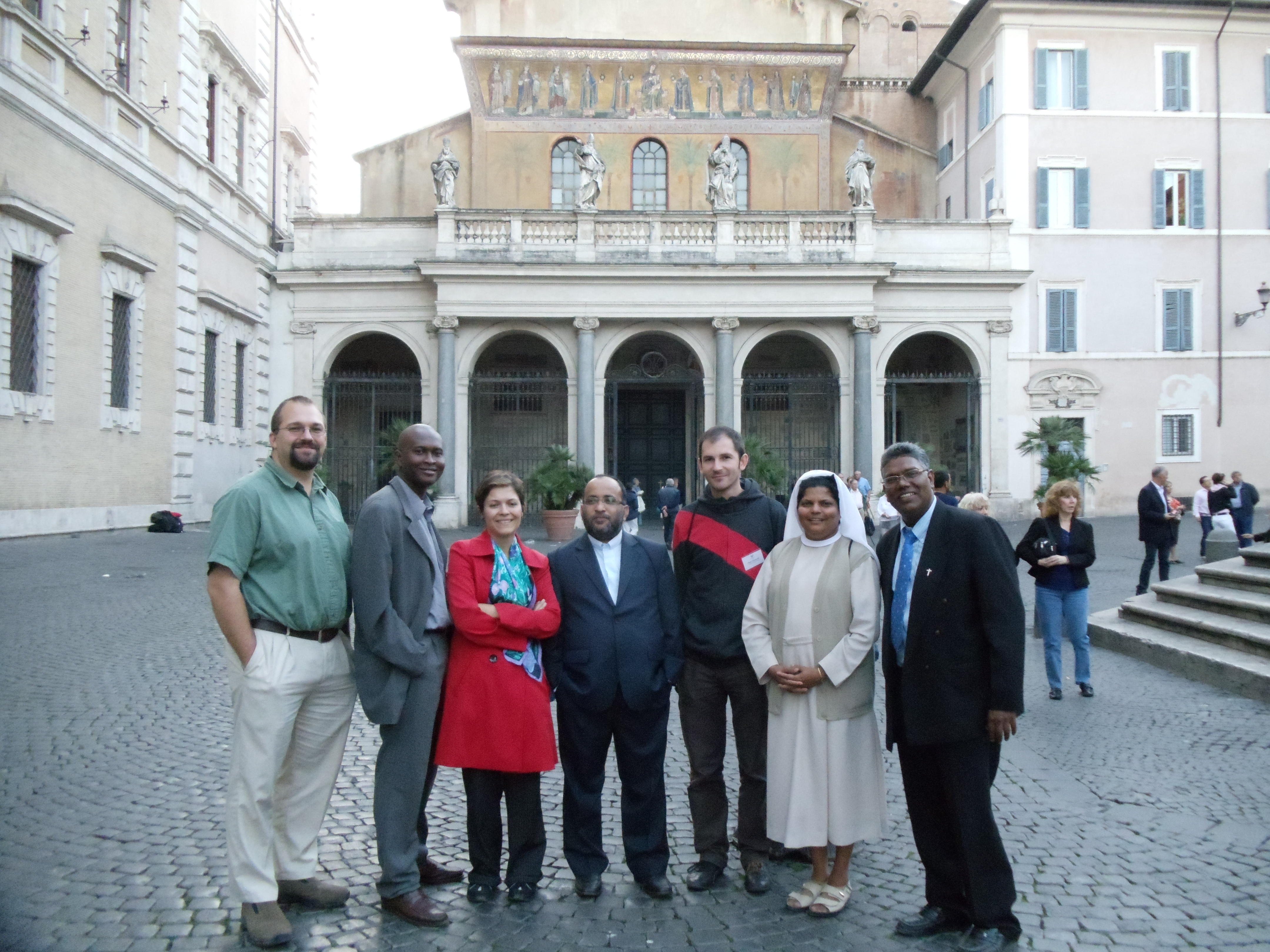
Piazza Santa Maria in Trastevere: AJ, Omar, Claudia, Bovas, Peter, Gracey, Michael
Our afternoon brought us back to the centre and across the river to PISAI – the Pontifical Institute for the Study of Arabic and Islam, where president Fr. Miguel Ayuso-Guixot, a Spanish Comboni Missionary of the Heart of Jesus gave an historical and theological overview of the encounter between Christianity and Islam. One of the oft-repeated metaphors of the week was one that Padre Miguel spent a few moments on – we are not looking for a “melting-pot” so much as a “mixed salad” when it comes to interreligious dialogue.
After a meander through the streets of trastevere, we met with Dr. Paolo Mancinelli of the Sant’Egidio community, one of Church’s best known lay movements, whose focus areas are direct work with the poor, peace and justice, dialogue and prayer. Paolo introduced us a little more to the work of the community, including Pope Benedict’s recent lunch with the community at their soup kitchen near Sant’Egidio.
We concluded the evening with evening prayer with the community at the church of Santa Maria in Trastevere, a 12th century church built atop the foundations of its 4th century former self. Around the corner was diner at Trattoria degli Amici, a now-familiar restaurant run by Sant’Egidio community and disabled friends. Good food and good company always make for an excellent discussion!
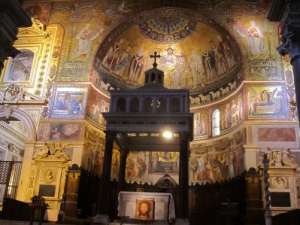
Santa Maria in Trastevere, interior
Official Catholic Dialogue with Judaism and Islam
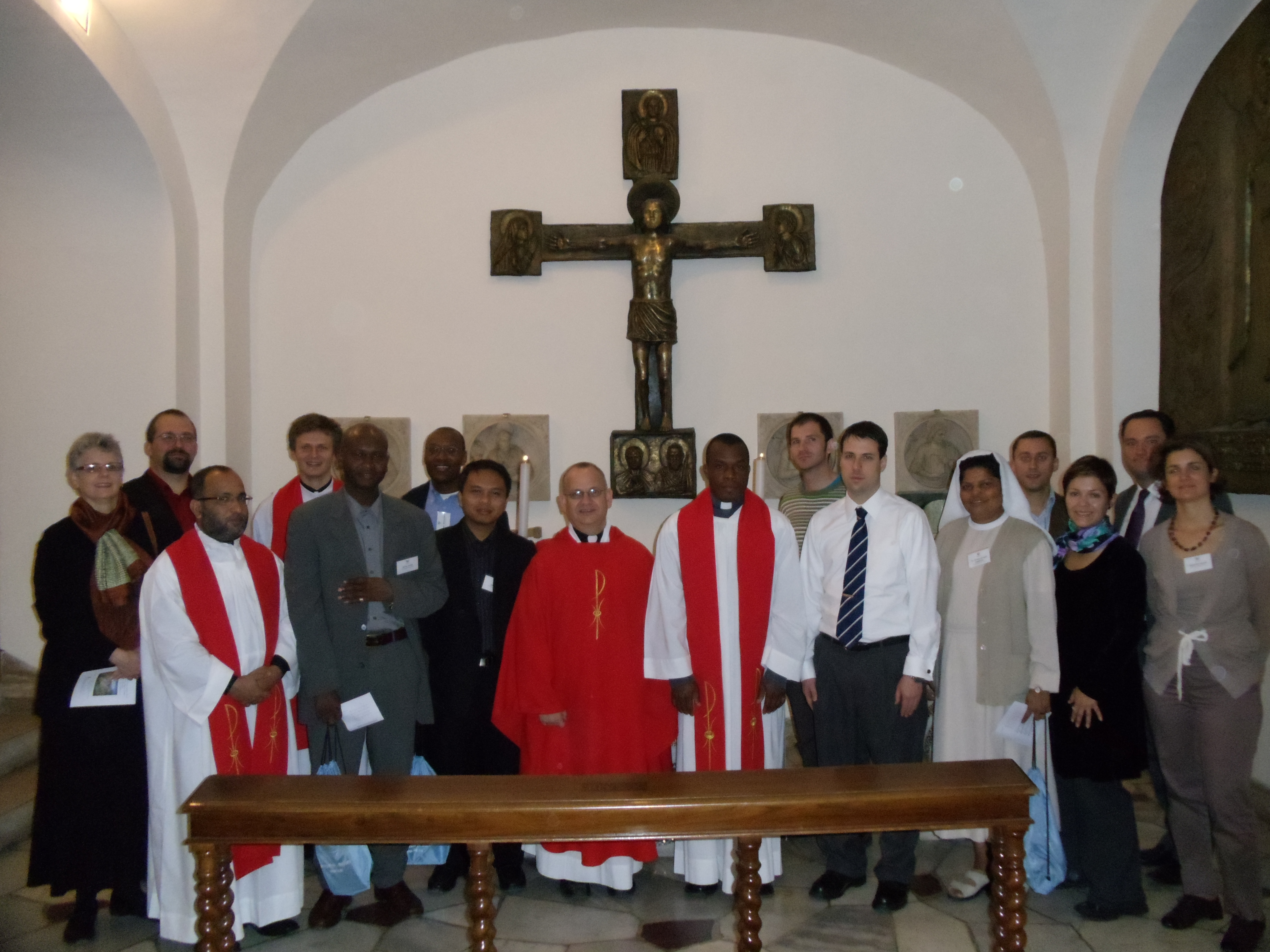
Russell Berrie Fellows at Chapel of the Patrons of Europe, Vatican Basilica
The second full day of our orientation began with a celebration of the Eucharist at the Vatican Basilica, in the Chapel of the Patrons of Europe just a few yards from the heart of the basilica, underneath the high altar. It was dedicated by Pope John Paul II in 1981 to the three first-millennium co-patrons of Europe: St. Benedict of Norcia and Sts. Cyril and Methodius of Thessaloniki. (The three second-millennium co-patrons, all women, were named in 1999.) The presider of our liturgy was Father Jess Rodriguez of the Jesuit curia, newly arrived in Rome to serve the English Secretariat of the Church’s largest religious order.
Noted art historian Elizabeth Lev joined us after the liturgy to give us a brief, but informative, insider’s tour of the basilica of St. Peter. Even for those who have been in Rome for years, something new was gleaned from her rich presentation. For me, it was the answer to one of the Eternal City’s eternal questions: “Hey Bernini, what’s with the twisted columns on the baldacchino???”
A short walk down Via della Conciliazione brought us to the offices of the Pontifical Council for Promoting Christian Unity, which for largely historical reasons, also houses the Pontifical Commission for Religious Relations with the Jews and a presentation from German Salesian Norbert Hofmann on the “Official Catholic Dialogue with Judaism”.
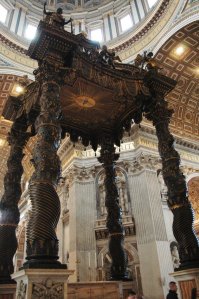
Bernini's Baldacchino
An afternoon of technical details broke for two more presentations: “Analysis of Nostra Aetate: Doctrine and History” by Thomas Casey, SJ and “The Official Dialogue of the Catholic Church with Islam” with German Jesuit Felix Körner of the Gregorian University’s ISIRC. The final discussion of the evening was a dinner dialogue with U.S. Ambassador to the Holy See, theologian Miguel Diaz, his wife and fellow theologian Marian Diaz, and the Canadian Ambassador to the Holy See, Anne Leahy. Their topic, understandingly, was “Diplomacy and Interreligious Dialogue”. We were joined by Drs. Armando and Adalberta Bernardini, president and vice-president of the International Foundation for Interreligious and Intercultural Education – and Fellow Paola’s parents.
Commitment of the Catholic Church to Dialogue
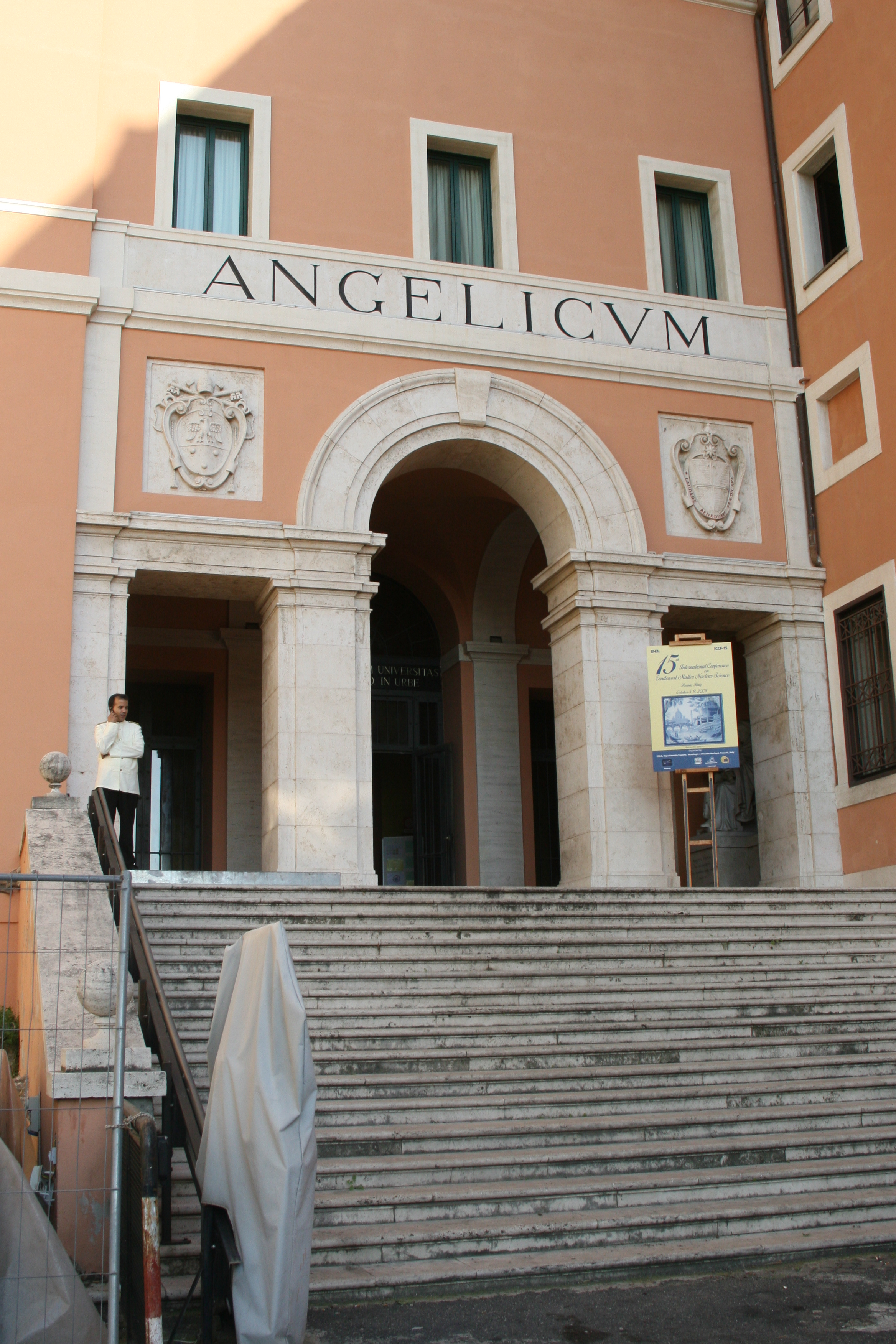 Monday brought us to the Angelicum with a welcome from Irish Dominican Michael Carragher, Vice-Rector and Canon Law Professor, and a brief tour from the new dean of the Theology faculty, Maltese Dominican Joseph Aguis. I learned more about the University in these 20 minutes than my time spent in its classrooms the last year. The university itself is the third oldest in rome, after Sapienza and the Gregorian, but its original location was next to the Pantheon in Santa Maria Sopra Minerva. The building that currently houses the university was originally a convent, repurchased from the government sometime after both sites had been taken in 1870. In what had been the chapter room, and serves now as the Sala de Senato, the full-body relic of an unnamed saint rests in the armor of an imperial roman soldier under the altar, unbeknownst to even some of the faculty who had joined us on our tour.
Fr. James Puglisi, SA, who serves as director of the ecumenical section and the Centro Pro Unione lead our first academic discussion on the “Commitment of the Catholic Church to Ecumenical and Interreligious Dialogue”. Like many of the presentations throughout the week, the content was review, but would certainly be helpful for those arriving without previous background in ecumenism and interreligious dialogue. We lunched at the Gregorian university bar, which is substantially larger than its Angelicum counterpart.

Thomas Casey, SJ pictured with NYU Professor Lawrence Schiffman
Following lunch, we ran into former Lay Centre resident Dimitrios Keramidas in his new role as secretary of the Missiology faculty at the Gregorian. He gave us an impromptu tour of his office and that of the Institute for the Interdisciplinary Study of Religion and Culture, as well as the Cardinal Bea Centre for Judaic Studies. We were joined there by Irish Jesuit Father Thomas Casey, director of the Bea centre, who introduced us to the research and work of the center, which includes 6000 volumes on Judaism in the Gregorian university library. This was followed by a 90-moinute introduction to the library there, which is the largest in Rome. At this point I calculated that if all the pontifical universities in Rome combined their libraries into a single collection, or at least a single system to which all pontifical students had access, it would be almost as large as the Hesburgh Memorial Library at Notre Dame.
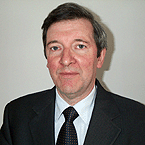
Gerard O'Connell, Rome Correspondent for UCANews
We returned to the Lay Centre for celebration of the Eucharist with the Theologian of the Papal Household, Polish Dominican Wojciech Giertych. This was followed by a dual-presentation and discussion over dinner with Fr. Giertych and Gerard O’Connell, Rome correspondent for the Union of Catholic Asia News service and author of God’s Invisible Hand, a biography of Cardinal Francis Arinze. The topic of their presentations was, “Issues that Matter to the Holy See: Seeing Interreligious Dialogue in its Broader Context”.
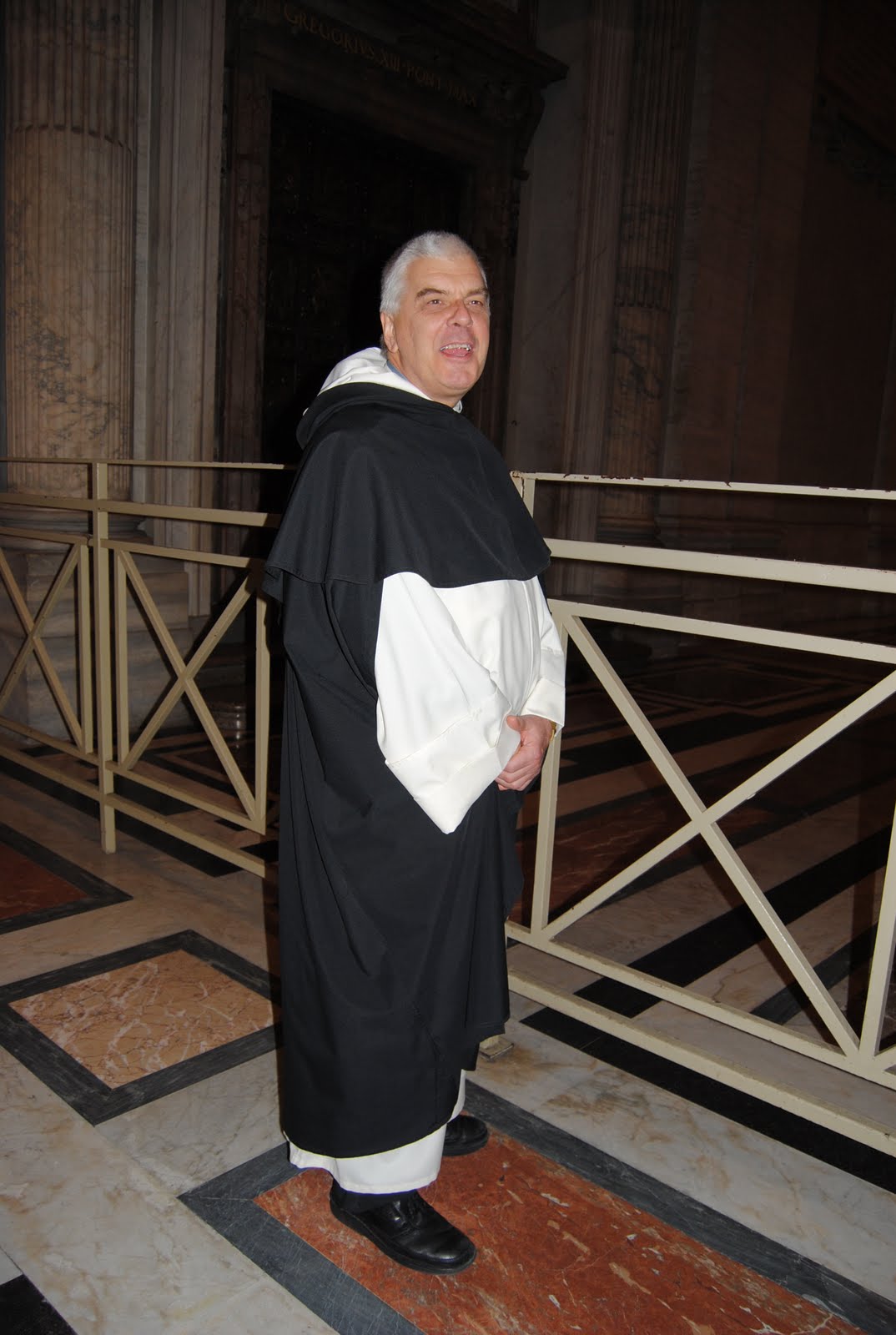
Wojciech Giertych, OP
The views were decidedly different, but not necessarily in opposition. Clearly a journalist and a theologian have different constituencies, frames of reference, and sensitivities when observing the Holy See; both men have had several years of doing so. Fr. Giertych raised a few hackles among some fellows with comments that grace comes through Christ and not through Buddha or Muhammad, but others countered that this is simply classical Christocentricism, inclusivist though it may be and in contrast to a more pluralistic view that is popularly construed as the most popular approach. (Whether it is or not is another discussion). At the least, it is helpful to be reminded that even in the administration of a papacy that is clearly pro-dialogue, there exist different methodologies and approaches to dialogue.
One of the burning questions of the evening revolved around whether Jews and Muslisms, at least, worship the same God as Christians. The Catholic Church has authoritatively taught that they do, and this has been cited from Gregory VII in the eleventh century to Nostra Aetate in the twentieth. Still, the thesis is challenged even within the church, and this fact lead to some pretty interesting conversation the rest of the evening. That, and another debate which started with one of the European fellows noting, “There is nothing new in Nostra Aetate. It is fifty years old, and it shows. We should be much further along than this!”
Back home in Rome
What a week! I returned to Rome on Sunday, 26 September with time enough for lunch and a nap before beginning an intensive orientation week for the Russell Berrie Fellowship. Though I started the program last year, the orientation and several other aspects are new this year, and we welcome the third cohort, as the first has finished their course of study (I am in the second).
The new Fellows include priests from Poland, Ruanda, Nigeria and India and lay scholars from Chile, Ukraine, Gambia, India and the U.S. (including one seminarian, one religious sister, and one Muslim). In addition to the Latin Church (“Roman Catholic”), three of the Catholics are Eastern: the Ukrainian Greek, Syro-Malabar, and Syro-Malankara Catholic Churches are represented. More had studied in Rome previously than with my class, and I was reminded how little my Italian has advanced in the last year.
The Lay Centre served as the ‘base camp’ for our orientation, and there is something about sharing my home in Rome with friends and fellow Fellows that gives a special joy. This truly is a place of hospitality and dialogue, of retreat and study, and it is only a pity that more of the Fellows are not also residents the rest of the year! Insha’Allah…
It was an impressive schedule. Our first evening’s introductory remarks were from Dr. Donna Orsuto (Lay Centre Director, Pontifical University Gregoriana) and Dr. Adam Afterman (Shalom Hartman Institute, Tel Aviv University).
Owing to the schedule, I am back-filling some of my notes, but dating them as though they were real time. I hope it makes sense!
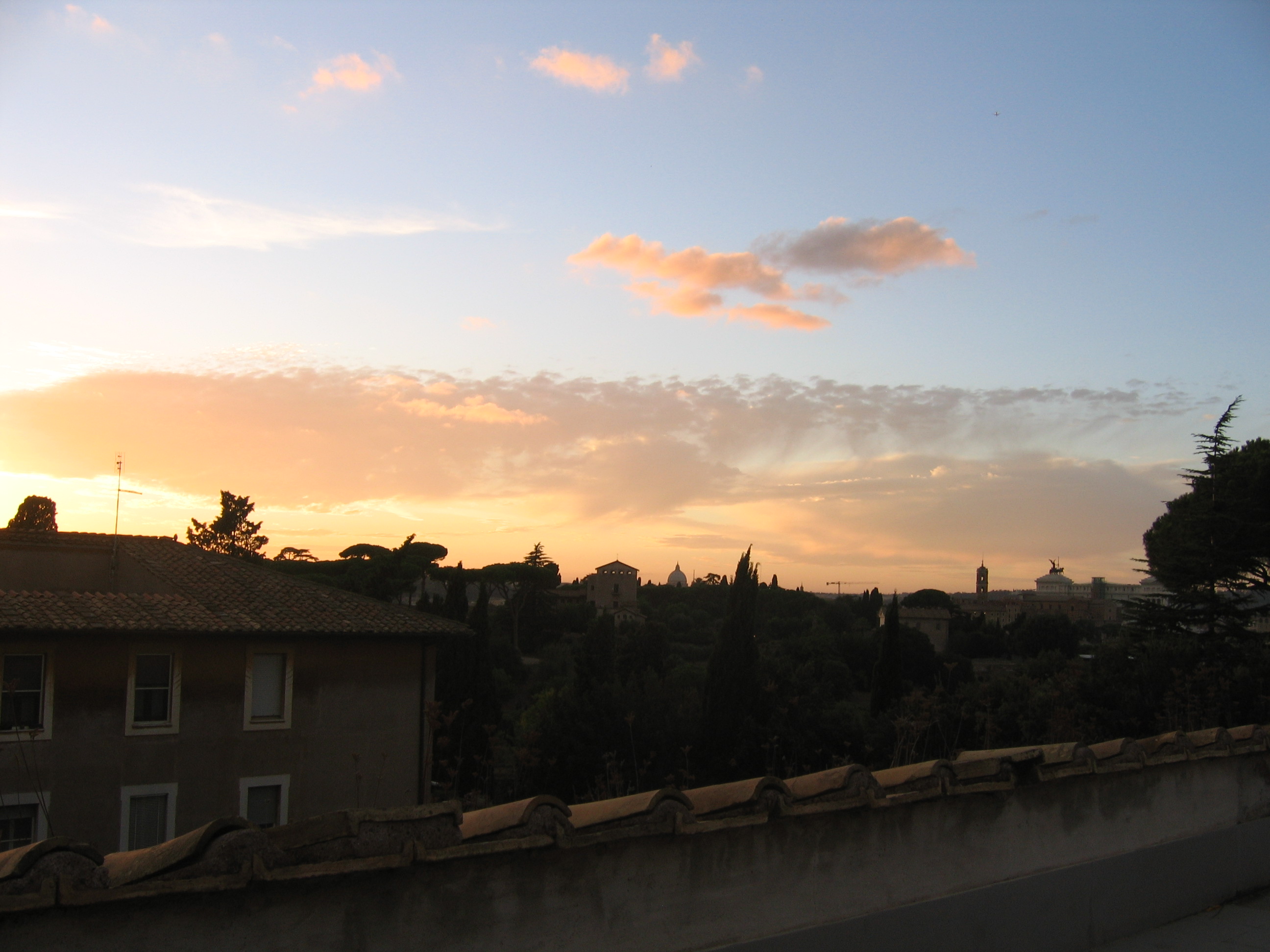
Nice to be back on the terrace
Archbishop-elect adiaphora
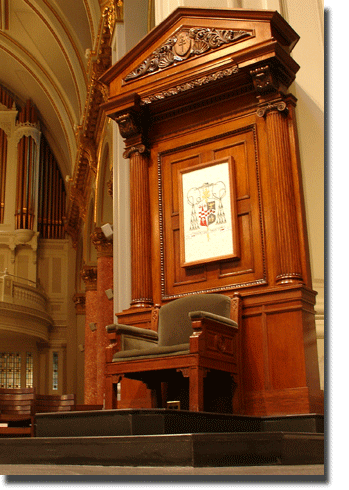 While looking for more information on Seattle’s new Metropolitan Archbishop, I came across a couple of interesting asides.
According to his introductory remarks yesterday, Bishop Sartain only got the call from the nuncio just a week before the announcement here and yesterday’s short-notice welcome liturgy. As I said, as late as Tuesday some key (lay) leadership in the diocese were still unaware of the pending announcement, and at least as late as Monday most priests of the diocese were likewise unaware. Pretty remarkable then that so many were able to gather for the welcome liturgy on Thursday, which our Cathedral staff documented nicely here.
The other interesting aside was the official announcement on Vatican Information Service, which seemed to make the archdiocese much larger than i thought it was. I cross-checked the diocesan statistics, and found a couple of discrepancies. Below is the blurb from VIS
VATICAN CITY, 16 SEP 2010 (VIS) – The Holy Father appointed Bishop James Peter Sartain of Joliet in Illinois, U.S.A., as metropolitan archbishop of Seattle (area 64,269, population 5,141,000, Catholics 964,000, priests 313, permanent deacons 104, religious 551), U.S.A. The archbishop-elect was born in Memphis, U.S.A. in 1952, he was ordained a priest in 1978 and consecrated a bishop in 2000. He succeeds Archbishop Alexander J. Brunett, whose resignation from the pastoral care of the same archdiocese the Holy Father accepted, upon having reached the age limit
VIS has the total population of the archdiocese at 964,000 – nearly double the archdiocesan statistic of 577,400. Instead of 313 priests, our statistics indicate a total of 290. Though when you add up the constituent numbers indicated by the diocese, you get another number entirely, 322. (131 active diocesan; 63 retired, ‘absent’, or active elsewhere; 96 religious; 32 externs). 100 deacons instead of 104, not so far off. Only 486 religious (men and women), though, instead of 551 – and it is not clear if the priest-religious are counted here as well.
One of my long-standing pet peeves is that you will note neither includes a statistic on lay ecclesial ministers, though a few years ago Archbishop Brunett commissioned a study in the archdiocese that indicated over 800, which does not include Catholic school teachers. Five years after the publication of the USCCB’s guideline document Co-Workers in the Vineyard, and more than fifty years after the first modern lay ecclesial ministers began service in the U.S., it is hard to believe that we are so well hidden that we cannot be counted!
New Archbishop for Seattle

Bishop J. Peter Sartain of Joliet
Since coming home for the summer, the rumors have been flying. Meeting over coffee or a local microbrew with pastors, curial staff, and local ecumenical leadership over the last several weeks, the two consistent questions have, “So, what is it like living in Rome?” and, “Who do you think the new archbishop will be? Have you heard any rumors over there?” A month ago, even the current AB was asking me the same questions, and not in that order.
This morning’s announcement came to me by text while I slept, out of town and disconnected from the internet. To be honest, it was also a bit of a surprise. So far, all I know about J. Peter Sartain is what I have read online (now that I have found a connection) and unsurprisingly the writer with the most to say about it is Rocco Palmo at Whispers in the Loggia.
Even as recently as Tuesday, folk here were still in the dark. Archbishop Brunnett had been out of town for his brother’s funeral, and though we have been anticipating the announcement shortly after Bishop Cupich’s Sept 3 installation in Spokane, Sartain’s name never seemed to be on anyone’s list. The favorites have been bishops like George Thomas, Gerald Kicanas, and, until the incident with the hospital administrator, Thomas Olmstead. Blase Cupich had been among them until tapped for Spokane.
Sartain is a native of Memphis, and has served as bishop of Little Rock, AR, and Joliet, IL. The hope for either a native Washingtonian or at least someone from west of the Rockies is again delayed, but most see the South and the Midwest as a better starting point than the East Coast (which, from here, starts at the Mississippi) considering the vast ecclesial and cultural differences at work.
Though the Hunthausen years started before I was born and ended with the Cold War, the memory of the Visitation and the pain it brought for the most involved Catholics in Seattle at the time is still strong. There are a lot who, not without reason, fear that the perspective remained in Rome that Seattle needs to be “reined in” – from what, though, would be a disputed question. (There is something for a future post!)
We are church in one of the most unchurched regions in the country. The fear of being run through the ringer again is felt even outside the Catholic community. One of the alternative weeklies, The Stranger, ran an article on their Slog yesterday asking, “Will Seattle’s Next Archbishop Be an Anti-Gay Doctrinal Conservative?” That should say something about the challenges our new bishop will face. The question is, as another blogger put it, how to be true to the faith without effectively becoming “Attila the Hun”, real or perceived.
At the same time, between new generations growing up without these memories and significant numbers of immigrants from out of state and out of the country, other concerns weigh as heavily.
For more than a generation, the number of lay ecclesial ministers have outnumbered priests in parishes, and the diaconate is now equal in number to the diocesan presbyterate and growing, while the later relies heavily on help from religious communities and foreign externs. Many are asking what the archbishop-elect’s experience is with creative ecclesial leadership.
More than thirty languages are used in the celebration of the Eucharist on a weekly basis, and nearly half the population of the archdiocese is Spanish-speaking. So is Bishop Sartain, apparently.
Seattle-area Christians have a long and strong history of ecumenical cooperation, though it has been more focused on social justice advocacy than on intentional ecumenism, ie the goal of Christian unity. Being religious in an overwhelmingly non-religious environment, interreligious dialogue is critical. At the same time, and indeed as an integral partner with dialogue, evangelization both “old” and “new” is a high priority.
Like anywhere in the U.S., we have a polarized church, with some groups of priests unwilling to even talk to others, the parishioners falling prey to the hyper-dichotomized political situation and bringing it into the pews. There have been situations where the pastoral staff of a parish, theologically educated and ecumenically involved, comes under fire from the lay leadership which is more likely formed by EWTN and pop apologists (or vice versa).
I once had a parishioner approach me, grateful for my presence as pastoral associate in the parish because, she said, “all the other parish staff in this deanery are pro-choice, and it is nice to have a pro-life person in charge!” Knowing most of my ministry peers, it was difficult to see how anyone could read them that way, but it is indicative of the tensions and mistrust in too many situations. Another time, a school parent and faith formation commission member told me they had a great pastor, but that the staff undermined his prophetic, orthodox teaching – unaware, apparently, that the pastor had hired each one of the staff to be collaborators with him in ministry to the parish, and fully supported their ministry. A third example came at the first meeting of a JustFaith group, when a parishoner introduced herself as “probably not belonging here, since [she] was a Republican” – as if Catholic Social Teaching depends on one’s political views!
It will be an interesting time for our Archbishop-elect, and I look forward to hearing more from and about him. As I learn more, I will share it! Please keep him, me, and all the People of God in Western Washington in your prayers!
Summer in the Great Northwest
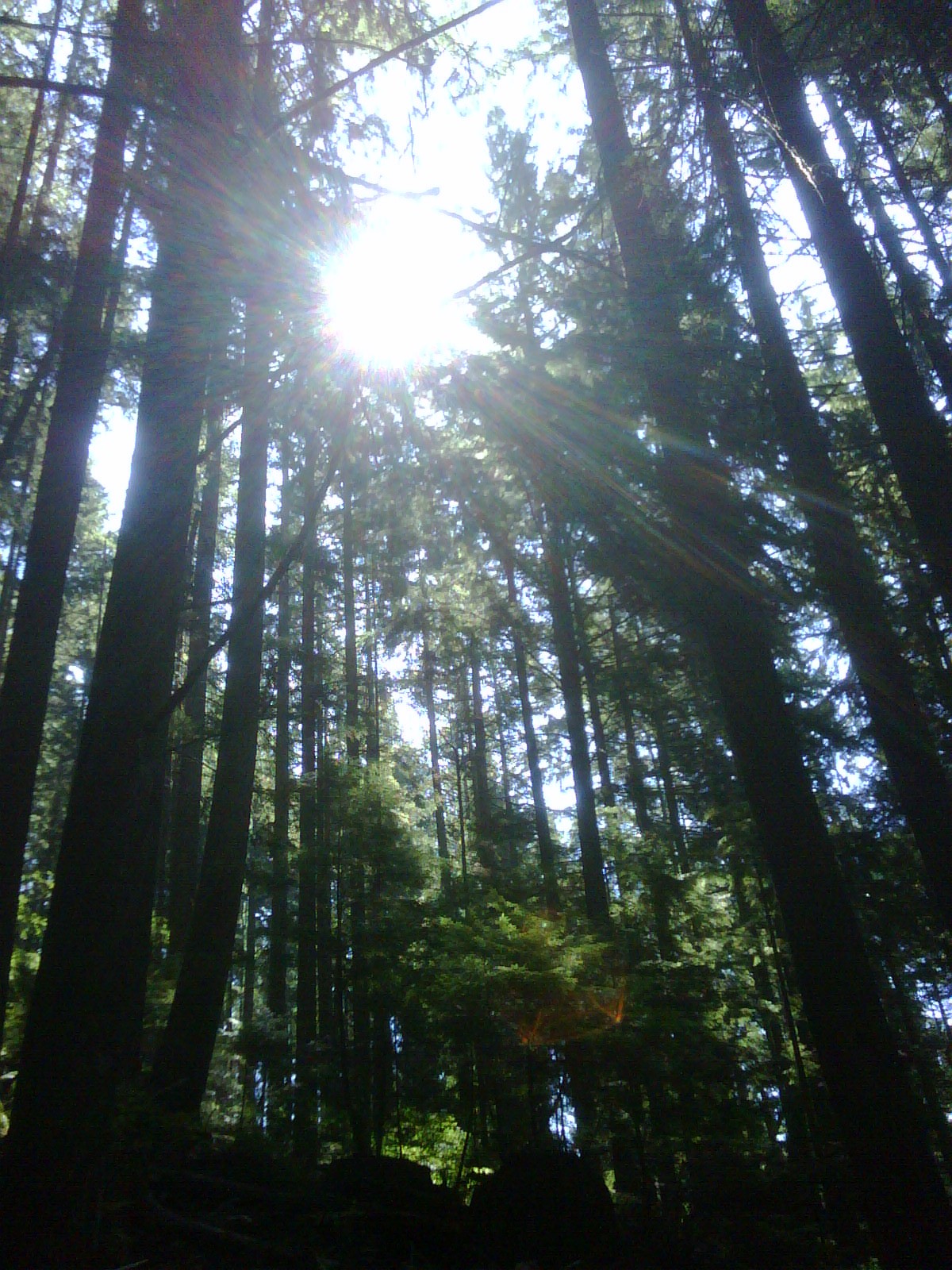
Hiking through Lynn Canyon Park in B.C.
School starts today for most of the schools around here, and the rest already have or are about to. During my last round of higher education, back around the turn of the millennium, the academic year ran from the last week of August to the first week of May. Now, in Rome, classes begin October 11 and final exams end June 30 or so. For the first time then, my summer break falls entirely and almost exclusively through summer (June 21-Sept 23). It is the best time of year to be in the Northwest, and to be out of Rome! Of course, the wind and rain of the last 36 hours has been more indicative of October than of August, but still, it is comfortable!
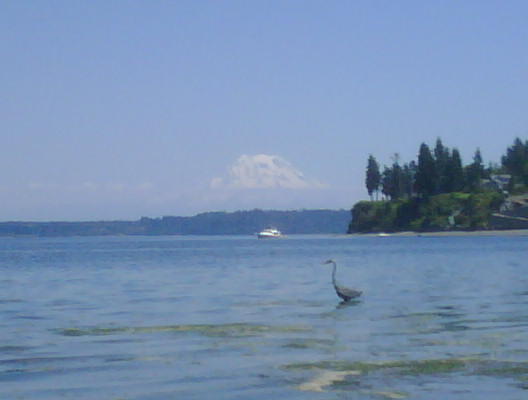
Mount Ranier, the Salish Sea, and a great Blue Heron, taken with my phone
For those who have been on thesis-watch since ’02, the only news I have to report is that with my move to the Angelicum, the M.A. thesis is no longer needed and some of the material will be transferred to the S.T.L. thesis which I will be writing this year. The general topic will remain on the diaconate and ecumenism, but a little more broadly than the previous iteration. This will lead into my eventual doctoral dissertation that will deal with the realities of ecumenical reception in the formation of pastoral ministers and/or and exploration of the non-sacerdotal ministries (ie, deacons, lay ecclesial ministers, et al.) in the ecumenical dialogues.
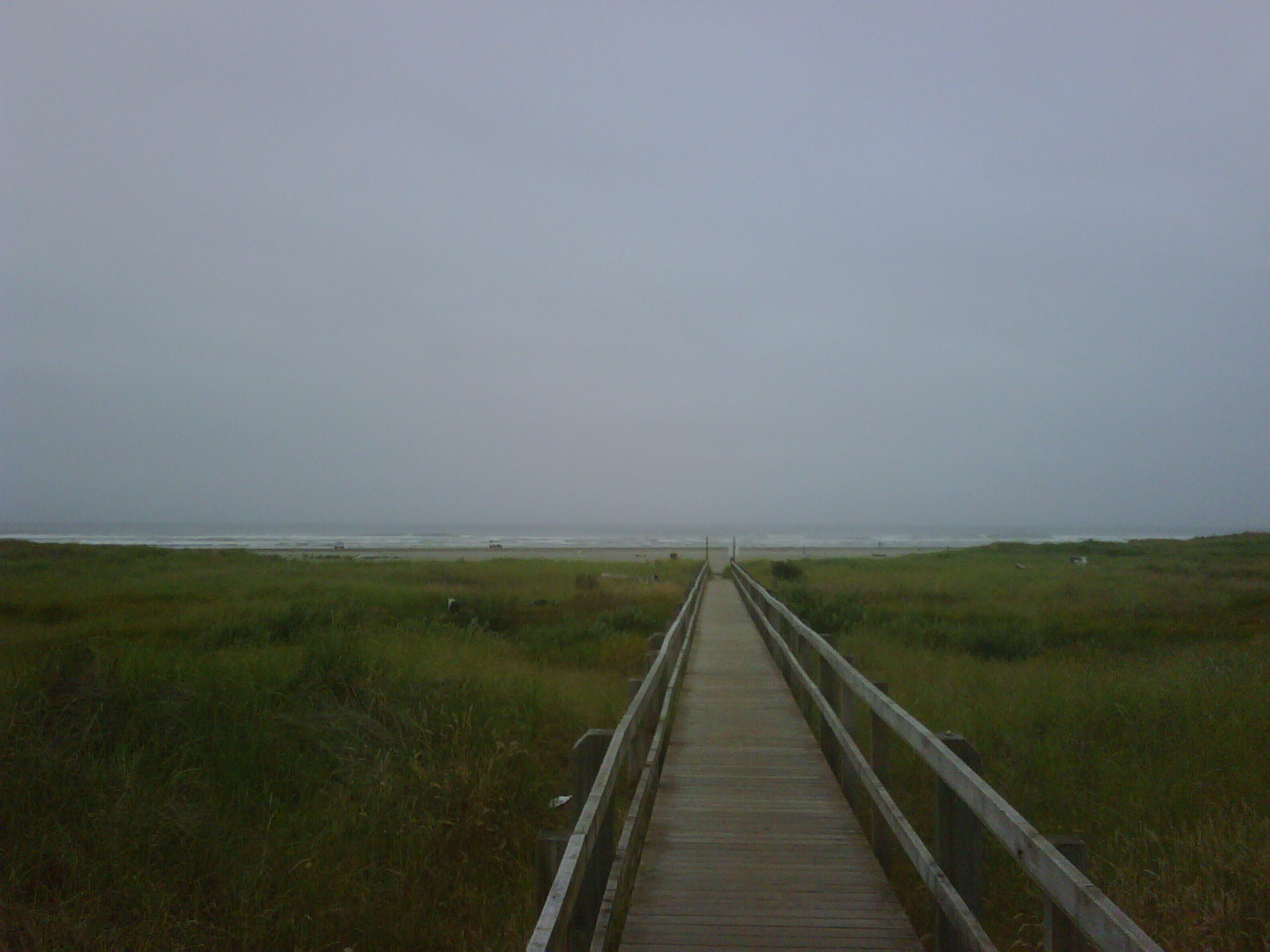
A path through the dunes, Ocean Shores, WA
Basically, in keeping with my hopeless advocacy for the ecclesial underdog, I want to know why most seminaries and other formation programs have failed to implement the Vatican’s required ecumenical formation – both intentional and integrative -, and to look into the ministries that everyone else seems to ignore – everything but bishop and presbyter/pastor – for their ecumenical opportunities.
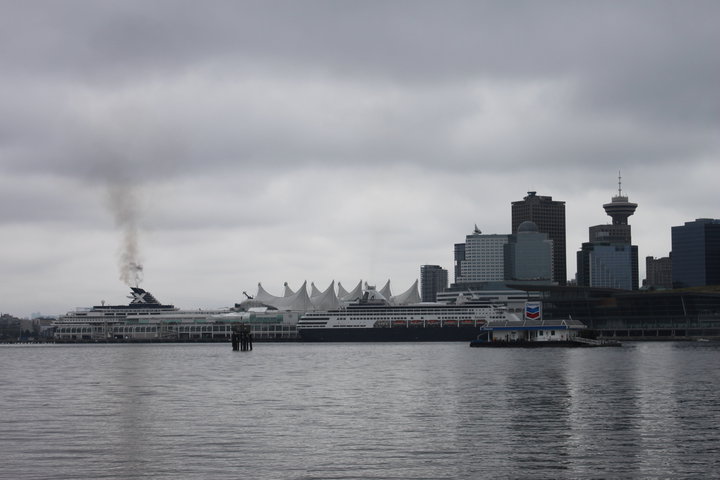
Vancouver, British Columbia, seen from Stanley Park (credit Julie Fritsch)
In addition to the Introduction to Ecumenism and Interreligious Dialogue I taught for the Archdiocese of New Orleans, I have taught a couple of courses on Eucharistic theology and practice for the Archdiocese of Seattle’s Liturgy Ministries Institute, and am consulting with a couple parishes on catechetical programs and parish consultative leadership. Other than that, most of my time has been spent with family and with friends. My two year-old nephew has been especially dangerous for my sense of time – yesterday I stopped by about lunch time, and left after dinner barely noticing those hours spent playing dinosaur, cars, and “shoot the daddy!”
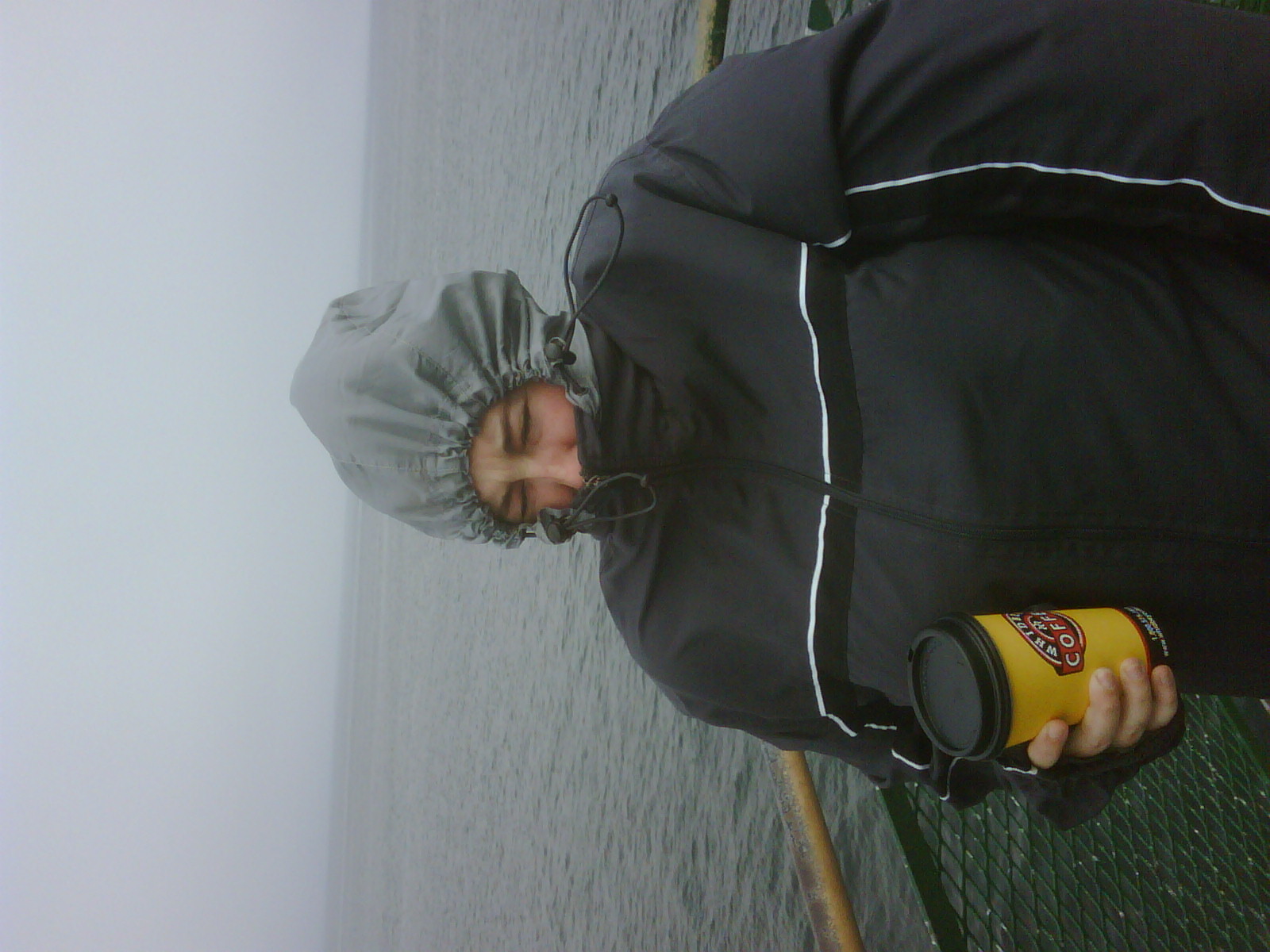
Nancy, while on a ferry through the San Juan Islands
After The Netherlands and New Orleans, my summer travels have been much closer to home, with a few trips to Vancouver, B.C., a trip to the San Juan Islands, and time spent down in the Olympia area and the beaches. (For those who have never been to a Washington beach, you just need to know three colors: sky-gray, sea-gray, and sand-gray. Any other color on the beach is man-made.)
I return to Rome in three weeks, and the normal updates will commence with a little more on the ecclesial and ecumenical developments of the Eternal City than just the travelogue, but plenty of both, most likely. Have a blessed last few weeks of summer, and for those already back in school, buona study!
Father Dominic of the Mother of God

Blessed Dominic of the Mother of God
Much is being made of today’s centenary birthday of Blessed Teresa of Calcutta, known in life as Mother Teresa, and rightly so. As the first, and so far only, pastoral associate of the first parish dedicated to her after her beatification, I had already developed something of a devotion to this latest holy Teresa. Living within a stone’s throw of the Missionaries of Charity Roman HQ helps too!
The Lay Centre is of course in a section of the Passionist Retreat of John and Paul, their international general house, where today is already tomorrow and one of their own is honored on the calendar. Blessed Dominic Barberi is likely best known for his missionary work on the British Isles and for being the priest who received Bl. John Henry Newman into full communion with the Catholic Church.
Our director, Dr. Donna Orsuto, is on an around-the-globe lecture tour this summer, and discovered a timely quote from one of Newman’s letters that describes my home in Rome and the case of canonization for the Passionists’ founder, St. Paul of the Cross:
On November 15, 1846 to his friend Dalgairns, Newman writes:
“What do you think of Mr. Spencer having joined the Passionists? I am very glad for Father Dominic’s sake. We went to their House here [Rome] with Cardinal Acton. It is very clean and beautifully situated. We saw the various remains (dress etc) of Venerable Paul—They expect he will be canonized by the end of three years. Suppose we all become Passionists.”
From The Letters and Diary of John Henry Newman, volume XI, p. 274.
The world just keeps getting smaller!
Teaching in New Orleans
What does a humanities graduate student do for summer work in this economy? “Not much” is the punch line most are looking for, but I have had a few rewarding opportunities for which I am grateful.
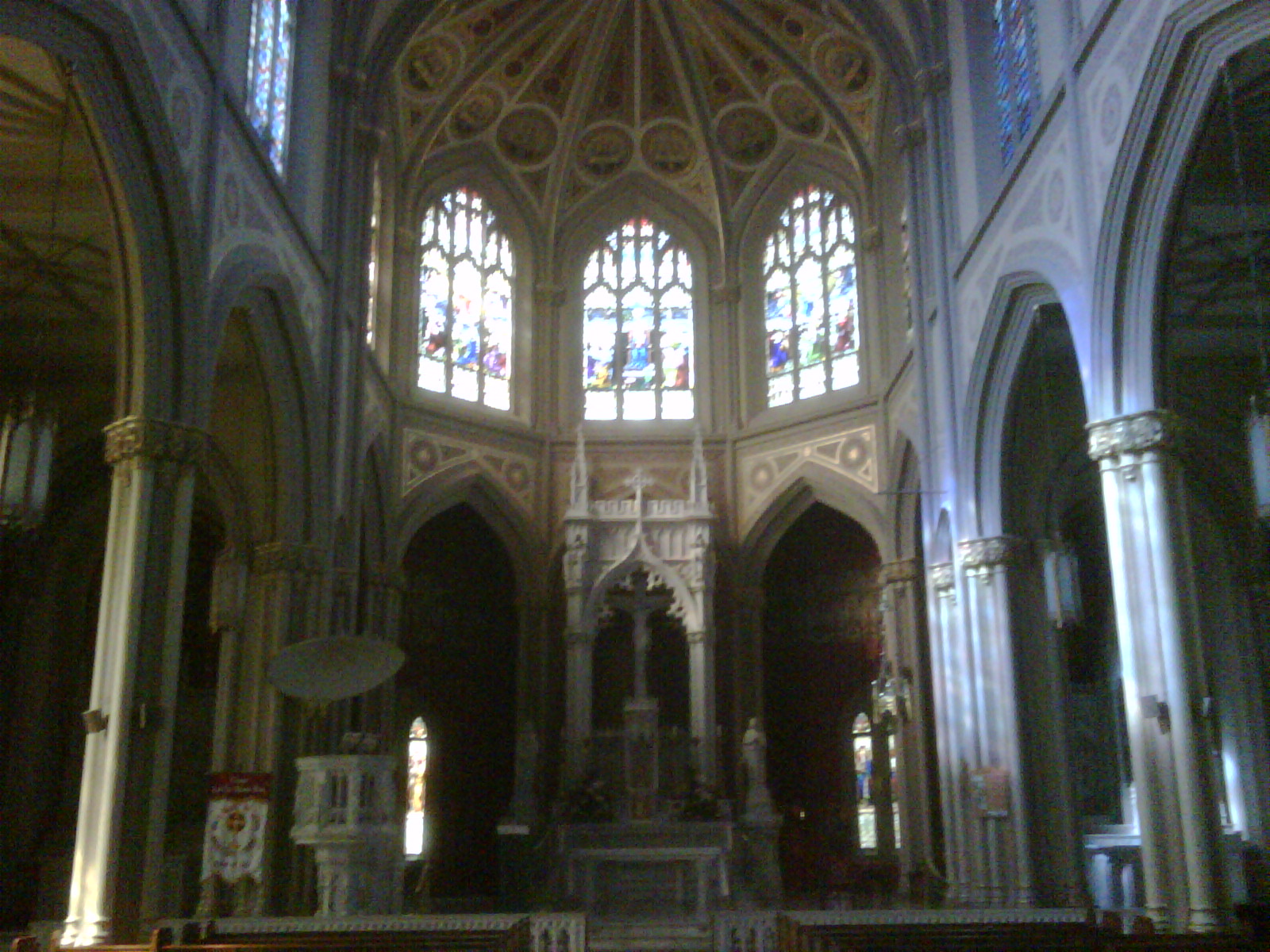
Holy Name of Jesus Parish Church, Loyola Unviersity New Orleans
There is still some room on my schedule for some others, if you know of any! Some of my usual work was not available – I have served as faculty or field staff for the Vicar for Clergy, the Faith Formation, Liturgy, and Youth & Young Adult Ministry offices in the past, but several budgets have been cut, and other classes were booked as early as January, and I only started looking in February!
I will be teaching two courses on the Eucharist for our Liturgy Ministers Institute, and working with a couple parishes on leadership development and reorganizational processes, but the most interesting offer was a 10-hour course for the Archdiocese of New Orleans’ Institute for Catechetics and Spirituality, which I taught this week. “An Introduction to Ecumenism and Interreligious Dialogue” – ten hours is nowhere near enough, but sadly more than most in ministry get!
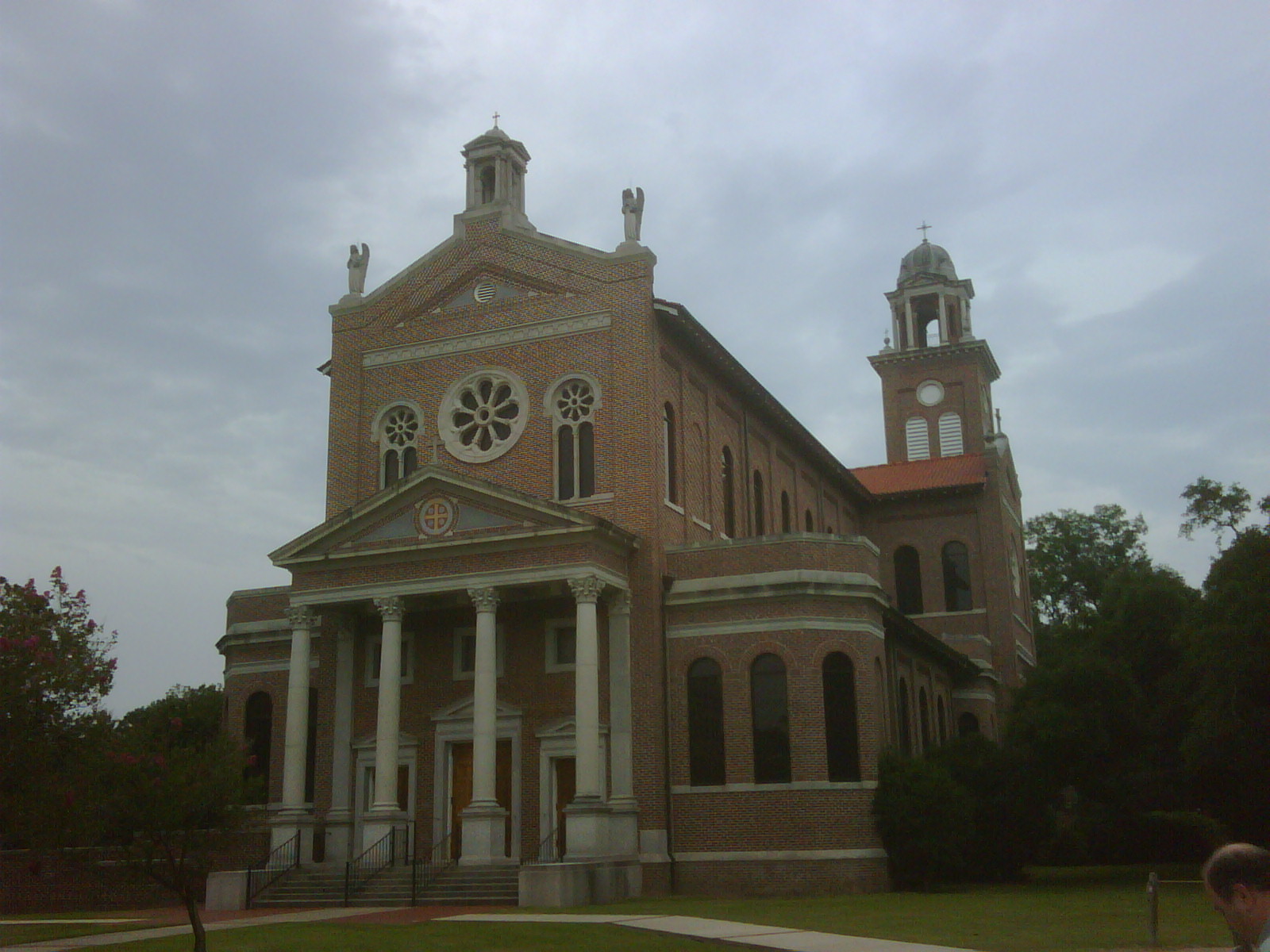
St. Joseph Abbey Church
The Big Easy was hot and humid, but a year and Rome had prepared me. I was only stateside for a few days and just about recovered from jetlag when I left back across the country on a flight almost as long as the one that brought me home from the Netherlands – a reminder that Euclidean geometry does not apply when making flight plans!
My host for the week was a friend and fellow ecumenist/lay ecclesial minister, Buddy Noel. My first moments in New Orleans provided an opportunity for prayer. On his way to the airport to pick me up, Buddy was caught in one of the South’s infamous downpours, and his car hydroplaned into the one in front of him in a backup on the Interstate. At least 12 cars were involved in a number of different collisions in the same area at the same time. His car totaled, Buddy was able to walk away with only bruises from the seatbelt and airbag. As he was making calls from the side of the road, his phone died. Long story short, he got a ride to the airport and had to have them page me, just a couple hours after his accident. I have been given great hospitality before, but this takes things to the extreme!
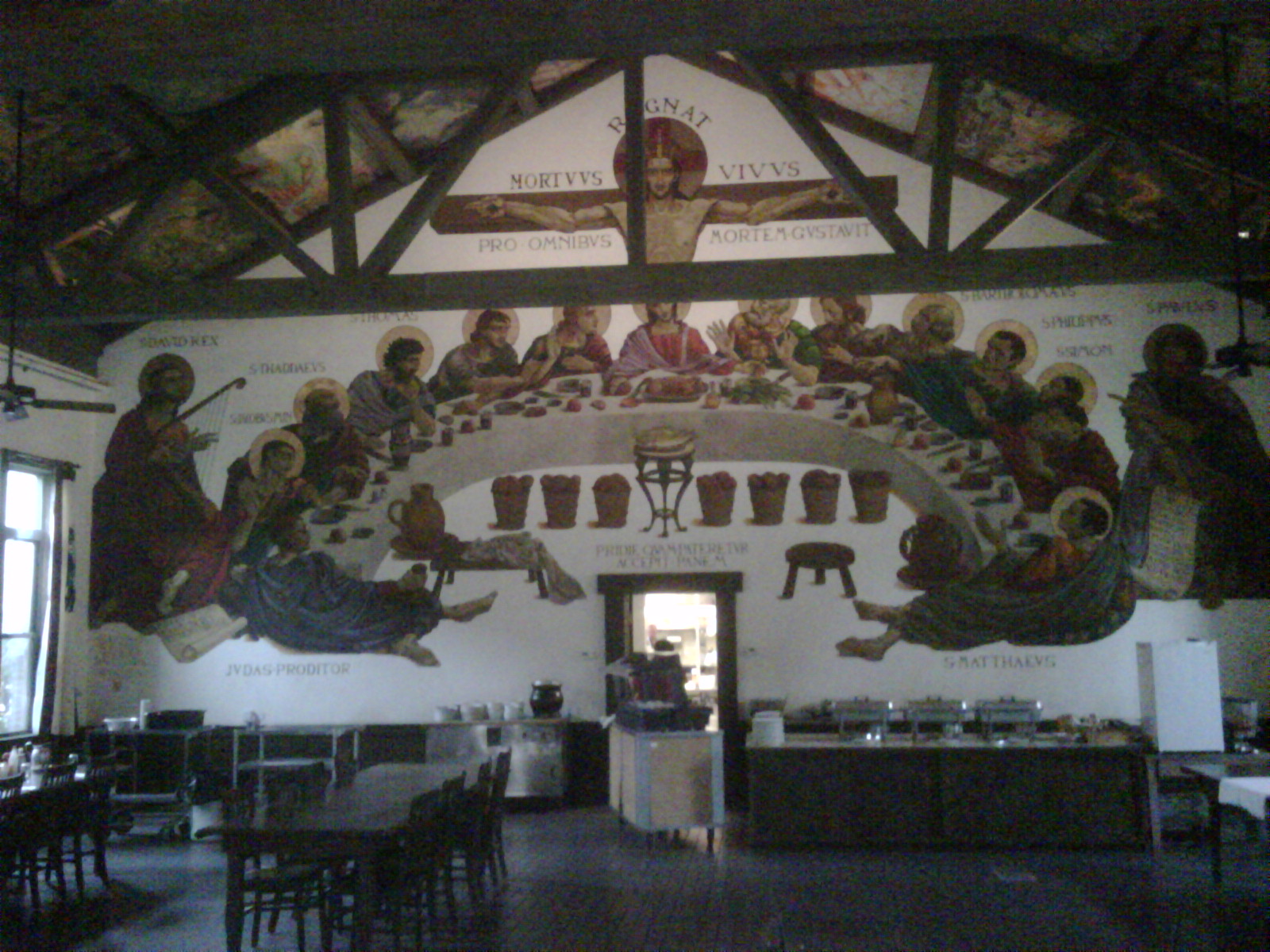
Last Supper, Refectory of St. Joseph Abbey
With a small group for the class, I was able to tailor much of it to some of the questions and expectations of the students, who were a mix of parochial school teachers, parish staff, and interested lay people. And nothing reinforces one’s own studies like teaching a topic, especially when you have to distill the highlights of a dozen years of study into a few hours. It also gave me plenty of time to talk with people and find out a little about the state of the church in one of the Catholic culture centers of the U.S. It was also only my second time to New Orleans, the last being just before Katrina; this time, they were just fitting the well with the new device to see if they could finally stop the largest oil disaster in history.
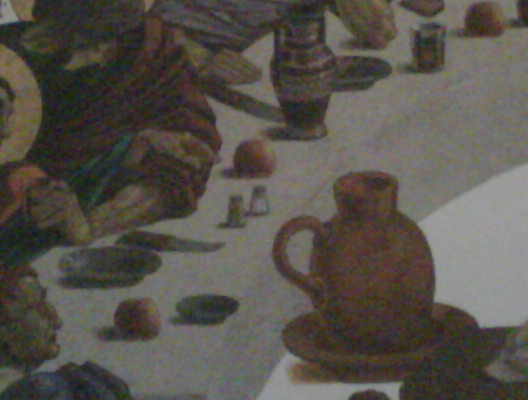
Last Supper (detail): Salt and pepper shakers, eh?
Archbishop Gregory Aymond has been the Ordinary there for just about a year, the first native of the diocese to serve as its bishop. Everyone I spoke with was positive about his appointment, with sentiments ranging from pride for a home-town boy done well to enthusiasm for his ecclesiology – and apropos to my visit – his commitment to local ecumenism.
The city has recovered its population and most of its infrastructure from Katrina, which hit nearly five years ago, but there have been changes. The Lower Ninth Ward looked like a field with a few funky, new houses scattered throughout – you would never know it had been a crowded urban neighborhood until the storm surge. There were still signs of the Katrina, a few gutted and abandoned houses throughout the city, a few roads sinking into the silt, but these were the exception rather than the rule. One of my students had been involved in a Chinese Catholic community that had been fairly active before the storm, whose members are now in diaspora around the country; A similar story with some of the small Eastern Catholic parishes in the diocese. Several people have simply moved to the other side of Lake Pontchartrain.
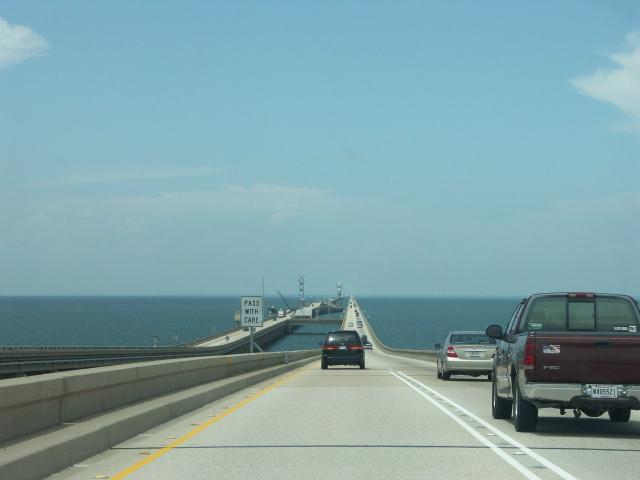
Lake Pontchartrain Causeway
The hospitality was generous and the food was excellent; the company was both! I was blessed to talk with new people each night, sample my first Po’Boys and some Gulf Coast seafood (sans oil), and wander the French Quarter, complete with obligatory beignet and Café au Lait. We prayed evening prayer with the Benedictines at St. Joseph Abbey, and I rode across the longest bridge in the world. Imagine driving onto a bridge and not being able to see land at the far side! The Lake Pontchartrain Causeway is about 24 miles (38.5km) from one shore to the other.
One little tidbit I picked up that fellow pastors and pastoral workers would find interesting, as well as the discussions around parish closings and reconfigurations after Katrina, was the relationship of parish and parochial school. Unlike the northwest, where a fractional minority of Catholic students attend Catholic schools, most in New Orleans do so. The relationship is a little better developed in some respects, as well – for example, the parish Director of Religious Education oversees the curriculum and instruction in both the parish religious education and youth ministry programs as well as the parish school classrooms.
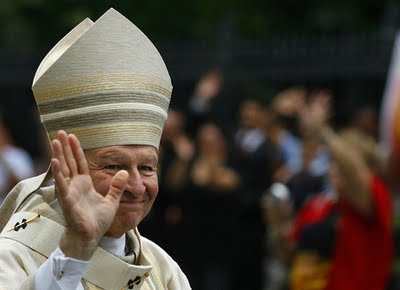
Archbishop Gregory Aymond of New Orleans
The Dutch, I Presume?
Holland and Netherlands are not the same thing, and the people and language are Dutch (though Flemish works, too). It does not help the rest of us, I suppose, that the Dutch national team was competing in the World Cup as Holland, though it was in fact the whole of the Netherlands represented. Holland is the western part of the Netherlands, one of the regions and once-independent states that combined to form the Netherlands, which itself is part of the region known variously as the Low Countries and the Benelux region (Belgium-Netherlands-Luxembourg).
In fact, while Eveline and I were touring the canals of Den Bosch, the volunteer tour boat captain asked the 20 people on board how many were from Holland. Considering I was the only person not speaking Dutch, I was surprised when Eveline was the only one to raise her hand – the rest were from elsewhere in the Netherlands: Friesland, Zeeland, Gelderland et al.
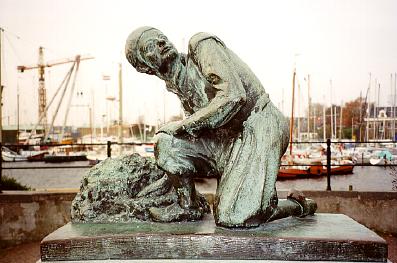
Hans Brinker, the boy everyone knows about for sticking his finger in the dyke to keep it from flooding. Everyone but the Dutch, that is.
A few people asked what my impressions of the Netherlands were, and what my expectations had been. Everyone seemed genuinely surprised that growing up on the far end of America, I had even heard about their country as a child. When visiting Kinderdyke, a picturesque concentration of nearly 20 windmills, we saw a notation in the guestbook reading, “It is a childhood dream come true to see these! Thank you!” The mild scoffing by the natives at the remark earned an explanation from me that indeed the mills and dykes of the Netherlands are known to us since childhood. Who knew that most Dutch have never heard of Hans Brinker?
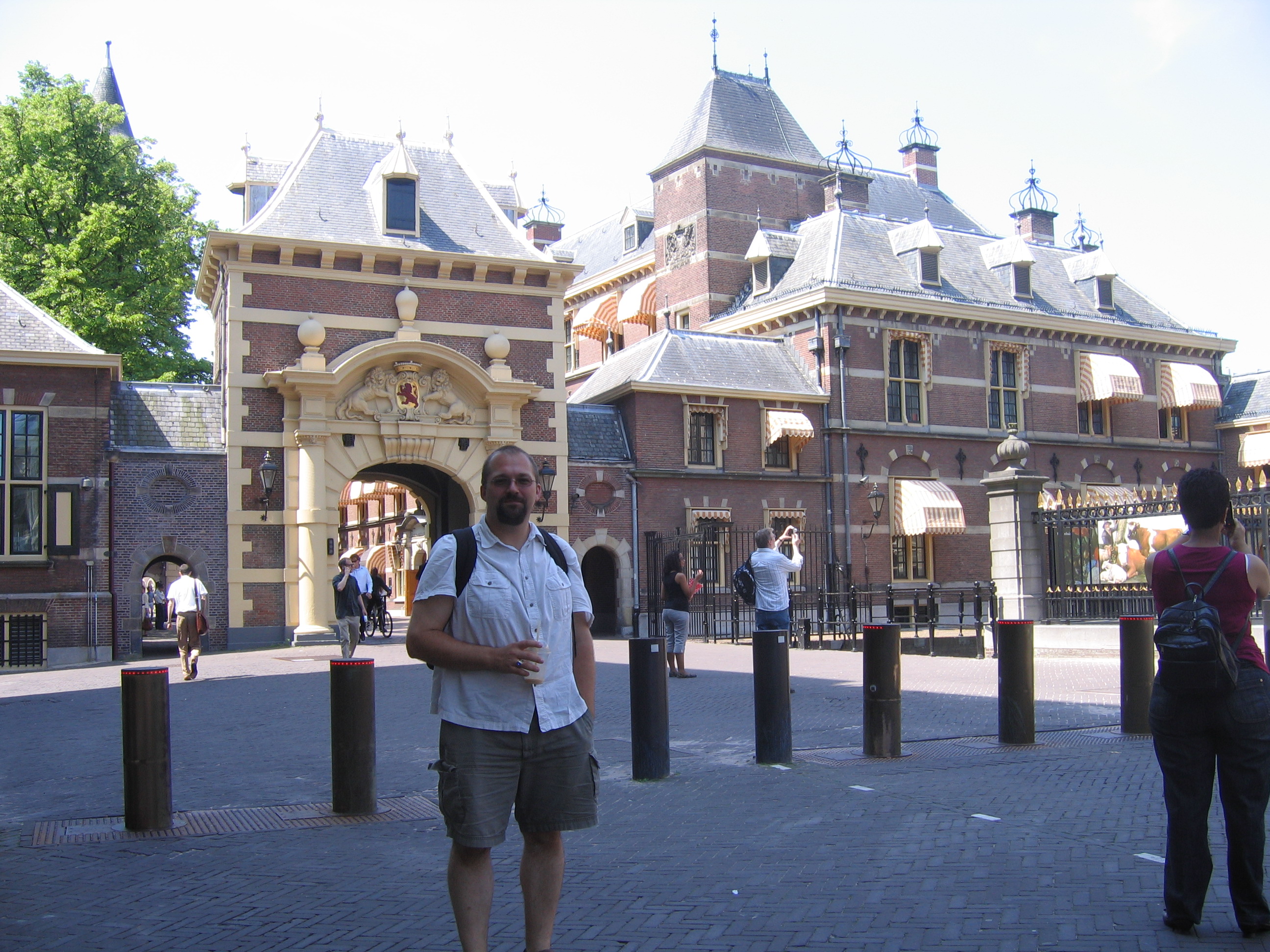
In front of the Binnenhof, home of the Dutch States-General (parliament)
A few words to describe my impressions? Fiets (bicycles)! Windmills, dykes, canals, and polders. Skating. Decorated bread! Drop (liquorice). Small country and houses. Friendly people, hospitality. Stroopwafels and Gouda (‘how-da’) cheese. [The Netherlands is about 16000 square miles – roughly 2/3 the size of Western Washington; the size of Massachusetts and Connecticut combined.]
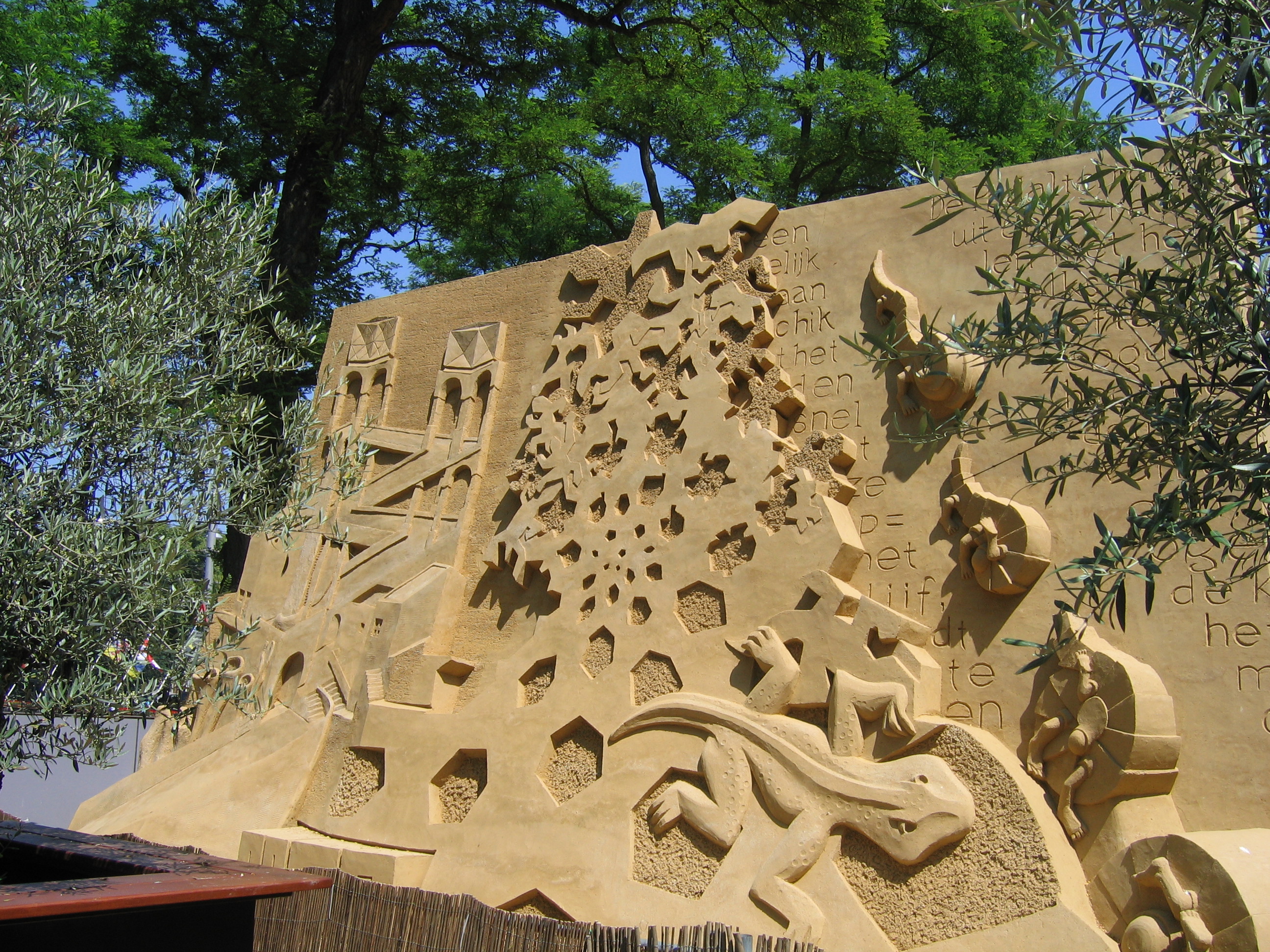
M.C. Escher tribute in sand
During a game of Dutchopoly, which was lost to the aforementioned theologian-diplomat, I got a pop quiz from her mom: “Do Americans know any [contemporary] famous Dutch people?” Schillebeecx, of course! And Visser t’Hooft. (Pronounced tohft, not tooft, I discover after the laughter subsides…) M.C. Escher is well known, but I doubt many know he was Dutch. Historical figures are more likely: Spinoza, Erasmus, Van Gogh. I had already mentioned Hans Brinker to mostly blank stares. But actors, musicians, athletes? Not so sure…
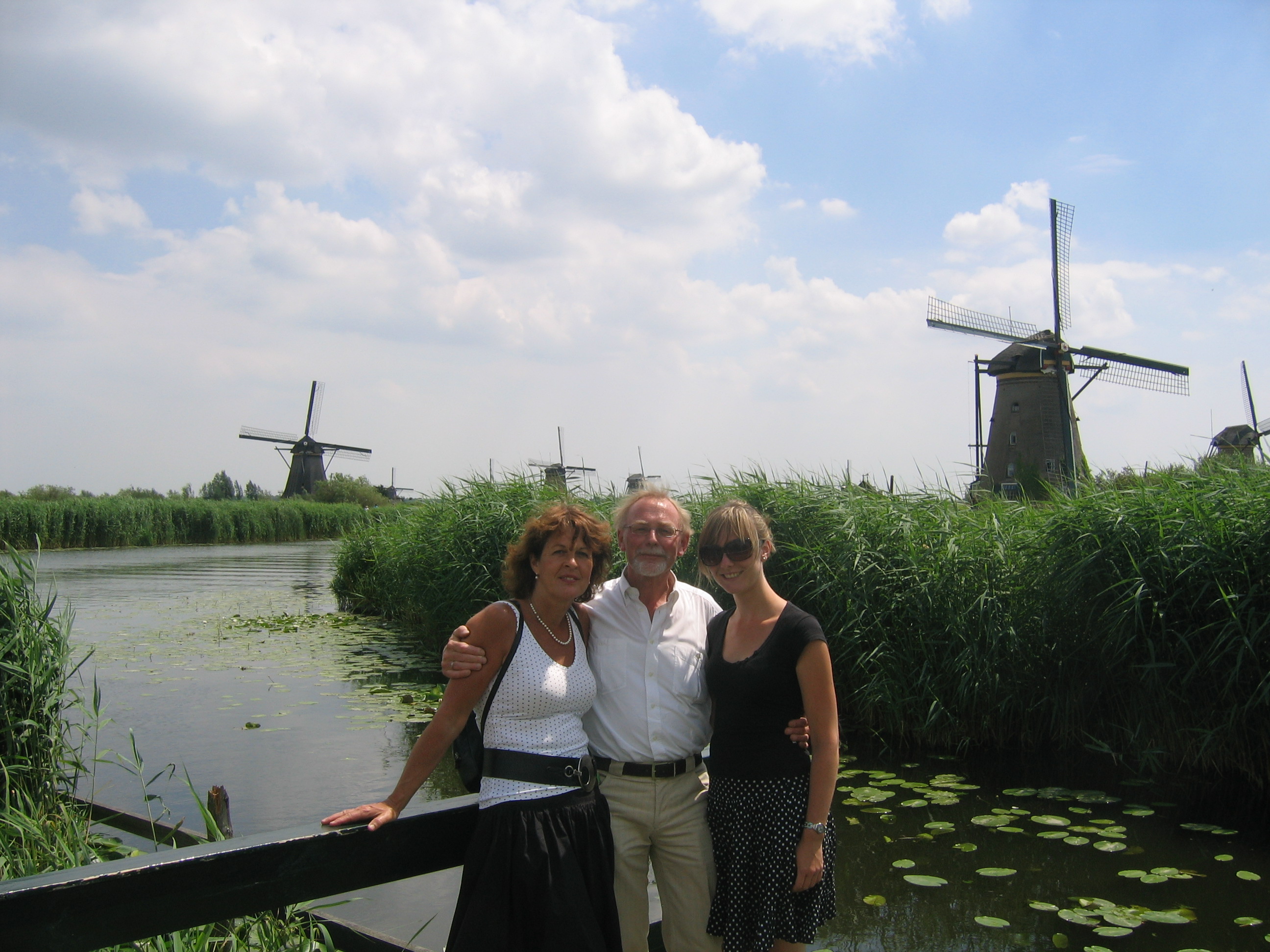
My generous hosts
After Amsterdam, I got a full day to explore the university town of Tilburg, Eveline’s college home for the last five years. Big, beautiful, rarely visited churches; bicycles in the tens of thousands parked at the train station; a large outdoor shopping district. I discovered almost immediately that the Dutch do not anticipate size-13 American feet when designing stairs.
Amsterdam may be the capital, but the seat of government is Den Haag (The Hague), which is where the Queen, parliament, and the embassies cluster, not to mention the international criminal courts. Like Amsterdam it dates from about the 13th century, and retains a great deal of European charm. A little less so, Rotterdam, which we visited next. Though an older city, its historic center was all but completely demolished during WWII. Definitely something to be in the midst of The Hague and the sea of orange as Holland won its way to the World Cup finals!
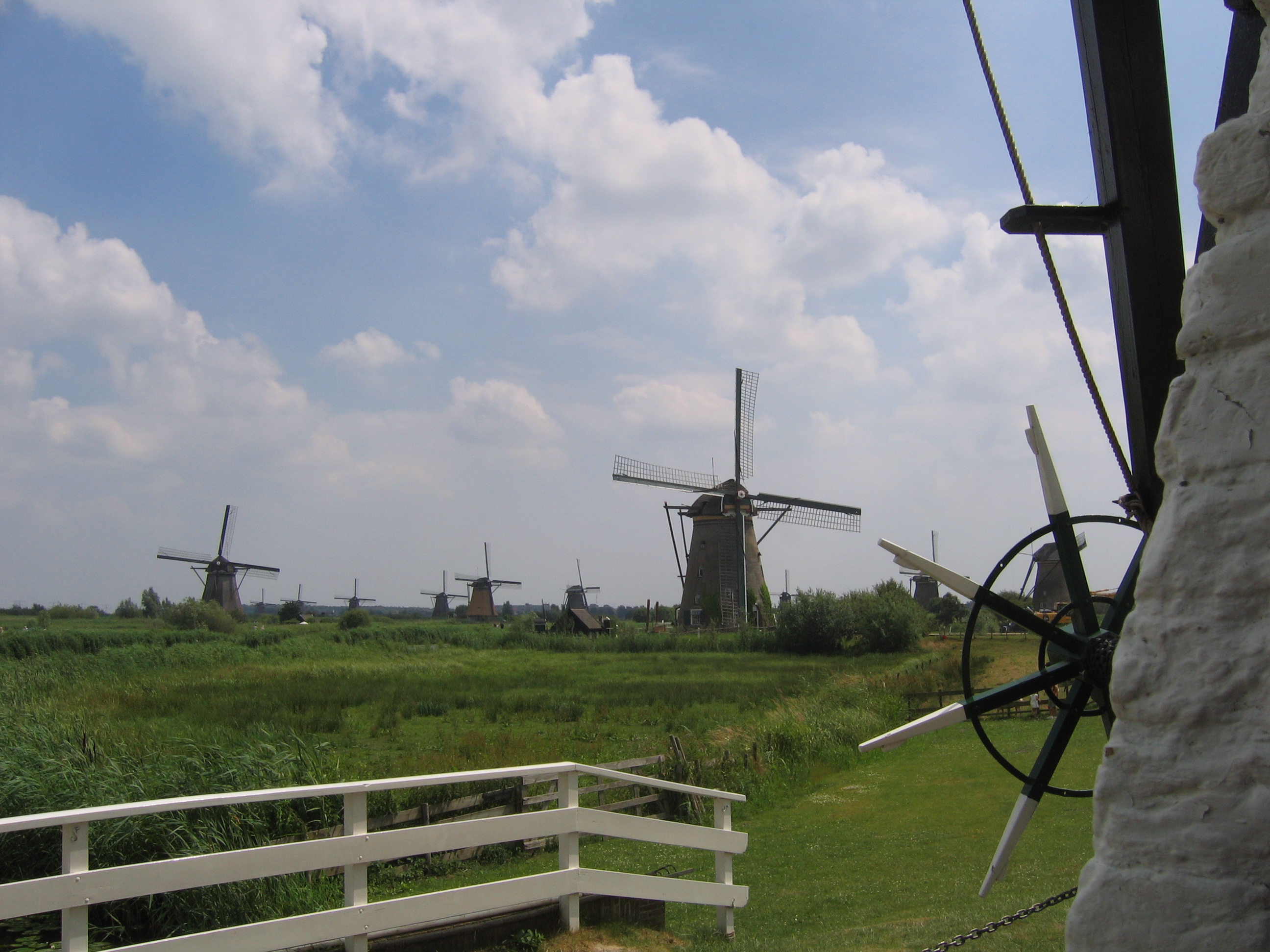
Kinderdyke
Over the weekend we retreated to Maasdam in South Holland, a small rural town where Eveline grew up and where her parents still keep her childhood house. Her father rides his bike 40 km to work daily, as he has for decades, and her mother has a pair of wooden clogs she still uses for working in the garden. We toured the island by fiets, and I discovered this is a lot easier to do when A) the entire country is flat and below sea level, B) you ride street cruisers rather than mountain bikes, and C) the entire country is crisscrossed with dedicated bicycle paths, not just 18” lanes on the side of a road!
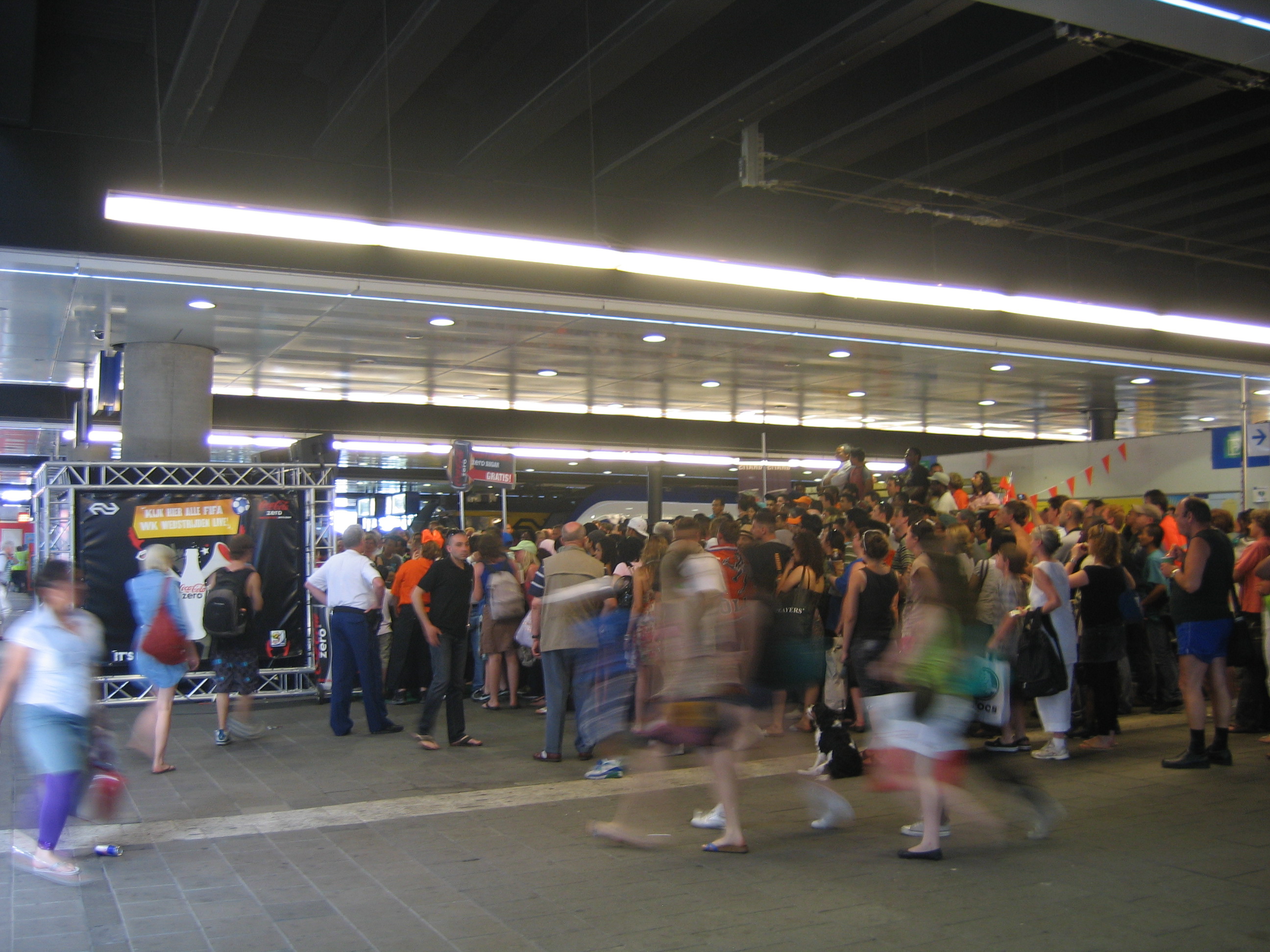
World Cup game ends in five minutes. Your train leaves in three. Where would you be?
Sunday was my first Fourth of July outside the U.S. Thanksgiving in Rome had had all the feel of home, a big feast and a gathering of friends, but there were no fireworks for me for Independence Day. (“So that’s why they always play that movie on TV today!” she says). There is plenty of Red, White, and Blue, however, since those are the colors of the Dutch flag as well – though Orange is the ‘unofficial’ color of the country, William of Orange being the ‘founding father’ if you will. We spent the afternoon touring the windmills of kinderdyke and the surrounding area. It is a little bit eerie to see rivers flowing through fields where the river is consistently higher than the land around it!
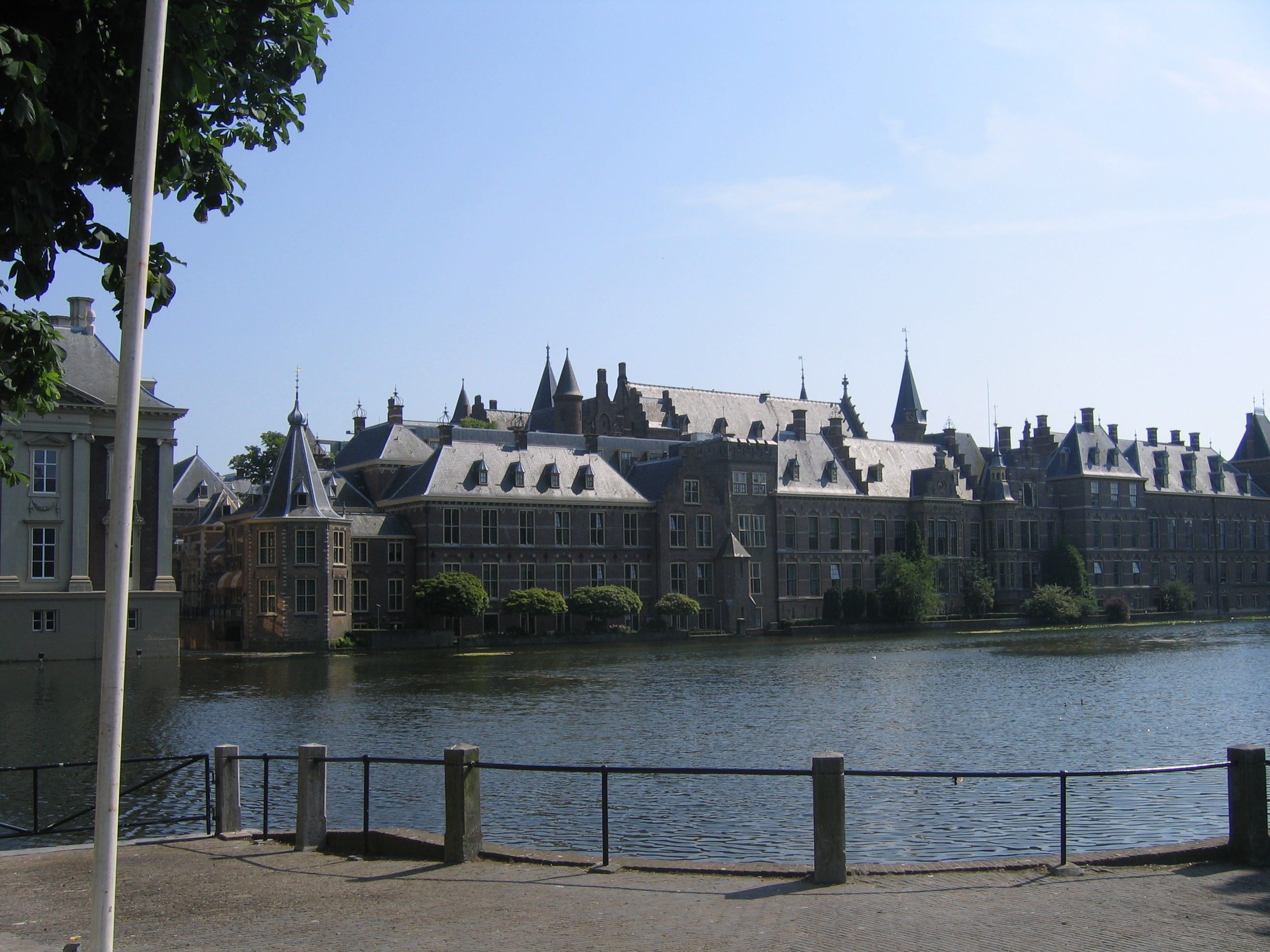
The Binnenhof
My last day was spent with a gathering of the Dutch clergy, honoring the end of the Year of the Priest, in ‘s-Hertogenbosch (Den Bosch for short). The guest of honor, presider and lecturer was the recently retired Cardinal Walter Kasper, who has been president of the Pontifical Council for Christian Unity for the last decade. Between the morning’s Eucharist and the afternoon’s lecture and vespers, we wandered around the town, sampled the famous Bosch Bollen, and toured the city from the canals that run beneath the city.
The cardinal’s address was delivered in German, and we were provided with Dutch translations in advance enough for me to glean the basic points from my host before the lecture began.

Cardinal Kasper in Den Bosch
(As I was searching for an English translation, I came upon a blog, In Caelo et in Terra, that included them and a photo from the event. I have commandeered both, so please give credit where it is due.) His remarks reflected on his more than half century of ordained ministry, and he addresses head-on the topics of clericalism and celibacy, and does not shy away from the scandal. His central point is that the priest must be a servant of joy, must put aside secondary attitudes (clericalism) and focus on Christ and his community. It was a fine way to end my year in Europe, in the company of a great friend sitting at the feet of a great teacher!
 The Ecumenism Blog